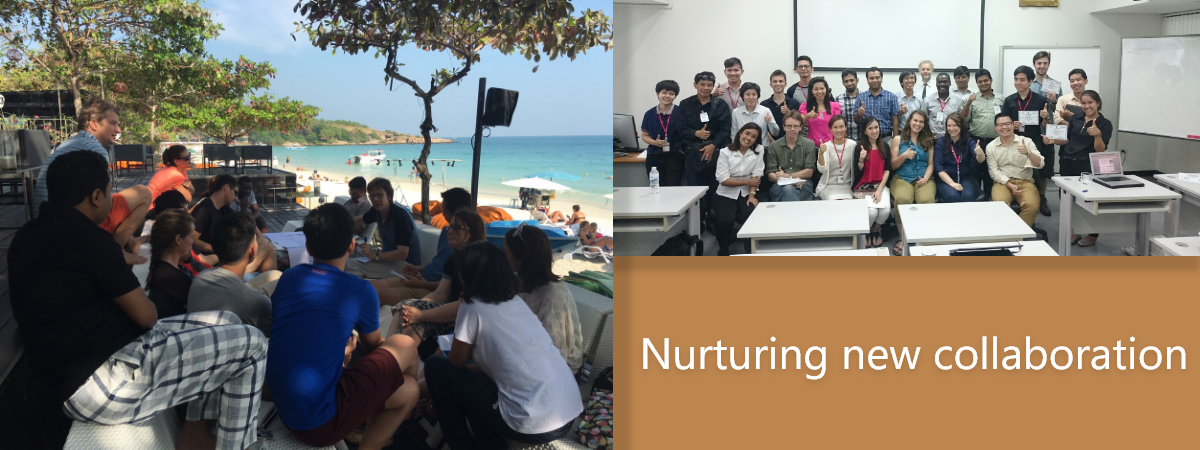

Mathematical Modelling Workshop: Within and Between-Host Dynamics of Drug-Resistant Pathogens. June 20-21.

1:59 am in News by Ben Cooper

Taught by staff from  Mahidol-Oxford Tropical Medicine Research Unit, Oxford University Clinical Research Unit in Viet Nam,  Harvard School of Public Health, University of Hong Kong.

Workshop dates: June 20- June 21.


Venue: Faculty of Tropical Medicine, Mahidol University, Bangkok.

Details: Antimicrobial resistance is one of the critical health challenges of the 21st century, with potentially far-reaching implications for the control of malaria, HIV, influenza, tuberculosis and many common bacterial infections. In addition to its direct impact on patient welfare, antimicrobial resistance is associated with a large financial burden to the health sector.

This workshop is offered jointly by the Mahidol Oxford Tropical Medicine Research Unit, the Harvard School of Public Health, the Oxford University Clinical Research Unit Vietnam and the School of Public Health at the University of Hong Kong. It is aimed at researchers with an interest in using mathematical models to help understand, control and prevent antimicrobial resistance. It will provide an opportunity for hands-on exposure to new modelling tools and approaches used to study both the within- and between-host dynamics of resistance, and to perform health economic evaluations of interventions. Practical examples will focus on malaria, influenza, and community- and hospital-acquired bacterial infections.

The course will follow the International Congress on Infectious Diseases at Bangkok  (http://www.isid.org/icid/).

Who should attend: The course is aimed at all researchers with an interest in using mathematical models to help combat antimicrobial resistance. Prior knowledge of mathematical models is not required, but researchers who have experience of working either with mathematical, statistical or economic models or with antimicrobial resistance data are likely to benefit most.

The course is free to those working in academic institutions and not-for-profit organisations. A limited number of places are available for those working in industry.

Cost: Free.

Registration is now open at : http://www.cvent.com/events/mathematical-modelling-workshop-within-and-between-host-dynamics-of-drug-resistant-pathogens/invitation-c1150f1b9de84837ae416dc1180a0159.aspx


by admin

TDModNet visiting fellows scheme

2:20 pm in Grants, News by admin

TDModNet visiting fellows scheme

Aim

To foster collaborations between members of TDModNet from different countries.

Background

TDModNet (Tropical Diseases Modelling Network) is a collection of mathematical modellers who work on infectious disease problems in the tropics.  Most members of the network are based in the Wellcome Trust-funded centres in Thailand, Vietnam, Laos and Kenya, though there are other members from Hong Kong, The Gambia, South Africa, Australia and other countries.  Combined, these modellers have expertise in population dynamics of infectious disease, within-host dynamics, evolution of drug resistance, malaria elimination, spatial epidemiology, genetic epidemiology, and health economics.  The critical mass within each country is small, while the degree of overlap across countries in research interests is high.  Moreover, data sets are large and often of mutual interest.  Thus the bringing together of modellers from different sites across the network could be highly productive.

The fellowship scheme

The idea is to give 1 or 2 researchers (Fellows) per year the opportunity to spend 1-4 months in a different Centre working on a project of mutual interest to both the host and Fellow.  This will be done by awarding up to £3000 towards travel, accommodation and subsistence costs to the researchers who present the most compelling written case for such a visit.  Applications should be no more than 1000 words (excluding references) and structured under the headings of Outline, Details of Research Project, Synergism and Budget, the latter with a signature from your Finance Officer to certify that the proposed budget suits the proposed length of stay.  These should be submitted by email to mmackinnon@kilifi.kemri-wellcome.org before the end of June 30th, Applications will be reviewed by senior members of the network (Lisa White, Maciej Boni, Margaret Mackinnon and two ad hoc members of the network outside the major Centres) and a decision will be communicated by July 15th, 2012.  The award must be used before the end of 2013.  A 1000-word report of the visit should be provided within 1 month of completing the visit.

Download a word template for the application here.


by admin

Tropical Diseases Modelling Network (TDModNet)

12:28 pm in Uncategorized by admin

Tropical Diseases Modelling Network (TDModNet)

TDModNet is a new network for mathematical modellers and their collaborators based in the tropics and working on tropical infectious diseases. There are members with a range of research experience (from graduate student to professor) and expertise (mathematicians, biologists, epidemiologists, malariologists, policy makers, geneticists, bioinformaticists, clinicians). The aim is to provide a forum to build mathematical modelling capacity in the developing world in a self-sufficient way by exploiting the pre-existing structure of the network members.

by admin

TDMod.Net Logo

5:30 pm in News by admin

Dear TDModNet members,

Here is the result of your vote for our TDMod.Net logo and the winner is C.

The total votes were 28. Thank you very much.


TDModNet virtual conference presentations online

11:42 am in Uncategorized by Yoel Lubell

TDModNet virtual conference – presentation recordings:

Bayesian modelling of hypnozoite activation in Plasmodium vivax
 by Ben Cooper, Wirichada Pan-ngum and Charlotte Metcalf

Population structure of circulating influenza A viruses in Vietnam, 2003-2008
by Ha Minh Lam

Effect of population size on evaluating drug resistance in individual-based malaria simulations
by Tran Dang Nguyen

Bayesian geostatistics in health cartography: the perspective of sickle haemoglobin

by Fred Piel  (note – there is a single recording of this and the previous presentation)

Indivaria: A Mathematica package for malaria parasite population dynamics modelling

by Sompob Saralamba

How multistate models will save the world

by Nantasit Luangasanatip

RSV modelling and the incorporation of contact structure
by Tim Kinyanjui

Modelling of the effect of pneumococcal conjugate vaccine on carriage and transmission of Streptococcus pneumoniae in Kenyan children

by John Ojal

TDMod.Net conference timetable – a few minor changes

11:08 am in News, Uncategorized by Yoel Lubell

Conference timetable (Bangkok time unless otherwise stated)

15:00 (08:00 GMT, 11:00 Nairobi,  16:00 HK, 02:00 Mexico City (Sorry about that!))  –  Introductions

15:15 – 15:30 -  Bayesian modelling of hypnozoite activation in Plasmodium vivax
 by Ben Cooper, Wirichada Pan-ngum and Charlotte Metcalf

15:30 – 15:45 – Population structure of circulating influenza A viruses in Vietnam, 2003-2008
by Ha Minh Lam

15:45 – 16:00 – Effect of population size on evaluating drug resistance in individual-based malaria simulations
by Tran Dang Nguyen

16:00 – 16:30 (Key Note speaker) – Bayesian geostatistics in health cartography: the perspective of sickle haemoglobin

by Fred Piel

16:30 – 16:45 – Indivaria: A Mathematica package for malaria parasite population dynamics modelling

by Sompob Saralamba

16:45 – 17:00 – How multistate models will save the world

by Nantasit Luangasanatip

17:00 – 17:15 – RSV modelling and the incorporation of contact structure
by Tim Kinyanjui

17:15 – 17:30 Modelling of the effect of pneumococcal conjugate vaccine on carriage and transmission of Streptococcus pneumoniae in Kenyan children

by John Ojal

Coffee Break (buy your own…)

17:45 – 18:15   TDMod.Net – current status and future plans

Discussion moderated by Lisa White

18:15 – 19:30 Workshop: Introduction to mathematical modelling using Berkeley Madonna

by Lisa White

TDModNet workshop 2011

9:02 pm in News by Sompob Saralamba

Tropical Diseases Modelling Network (TDModNet) Workshop 2011

“Modelling Infectious Diseases in the Tropics: from Design to Application”

11-13 July 2011 @ MORU Bangkok Thailand

Rationale for this Workshop

This meeting was the first workshop specifically designed for mathematical modellers in tropical countries. These researchers are typically at an early stage of their careers, without the support of a well-established international modelling group. They have specific interests in the transmission and control of tropical diseases and often an enhanced opportunity to influence the health policy of their country compared with modellers at an equivalent stage in their careers in the developing world.

Photos